Why Your First Sales Hire Outperforms Your Second (And What to Do Before You Hire Again)
Your second AE struggles not because you hired wrong, but because the system that made your first hire succeed was never built. Here's what's actually happening and how to fix it.
ONBOARDINGSALES-ENABLEMENTREVENUEGTM-STRATEGYSALES-PLAYBOOKS
4/13/20263 min read


There's a pattern I keep seeing play out when companies scale past their first sales hire. The first AE performs well. The second one struggles. The founder assumes they made a bad hire.
Almost always, they didn't.
What actually made the first hire work
Think about what your first AE actually had.
You answered every question in real time. You jumped on calls with them. You debriefed every deal. When a prospect pushed back in a way that usually kills a deal, you told them exactly how to handle it next time.
They didn't ramp fast because you had a great onboarding program. They ramped because they had a full-time founder as their personal coach. That's not a system. That's just you being available.
Then you hired the second one. By then, you're in board meetings, closing an enterprise deal, reviewing the product roadmap. You're not available the way you were.
So Hire #2 turns to Hire #1. But Hire #1 can't fully explain what they know. Half of it is tribal knowledge absorbed from you without either of you realizing it. The exact framing that works on a skeptical CFO, the moment in a demo when the prospect's energy shifts, the rare objection they've never heard more than twice. That knowledge lives in experience. It was never written down.
Month four
By month four, the numbers look strange. First rep is crushing it. Second is working just as hard but getting about half the results. You start wondering if you hired wrong.
Here's what the data says. Organizations with a formal onboarding process see ramp times roughly 10 weeks shorter than those without one. At $80K OTE, 10 weeks is about $15,000 in delayed revenue contribution per hire.
Scale that up. If you've hired three AEs, by month nine one will be hitting quota, one will be close, and one will likely be gone, taking with them around $80K in salary, $20-30K in recruiting fees, and months of pipeline that never materialized. The one who's almost there has been running at 40-50% of quota for six months while you tell the board they're getting there.
And that's before you factor in the time your VP of Sales spends in 1-on-1s answering questions that should already have answers somewhere. Run the full number. A single wave of three hires can cost $300K or more, not from a bad hiring decision, but from an unprepared system.
That Notion page that isn't a playbook
Most founders hit this point and do the obvious thing. They open Notion and start typing. An hour later they have something covering the product, the ICP, a few objections, some call tips. They call it a playbook.
It isn't.
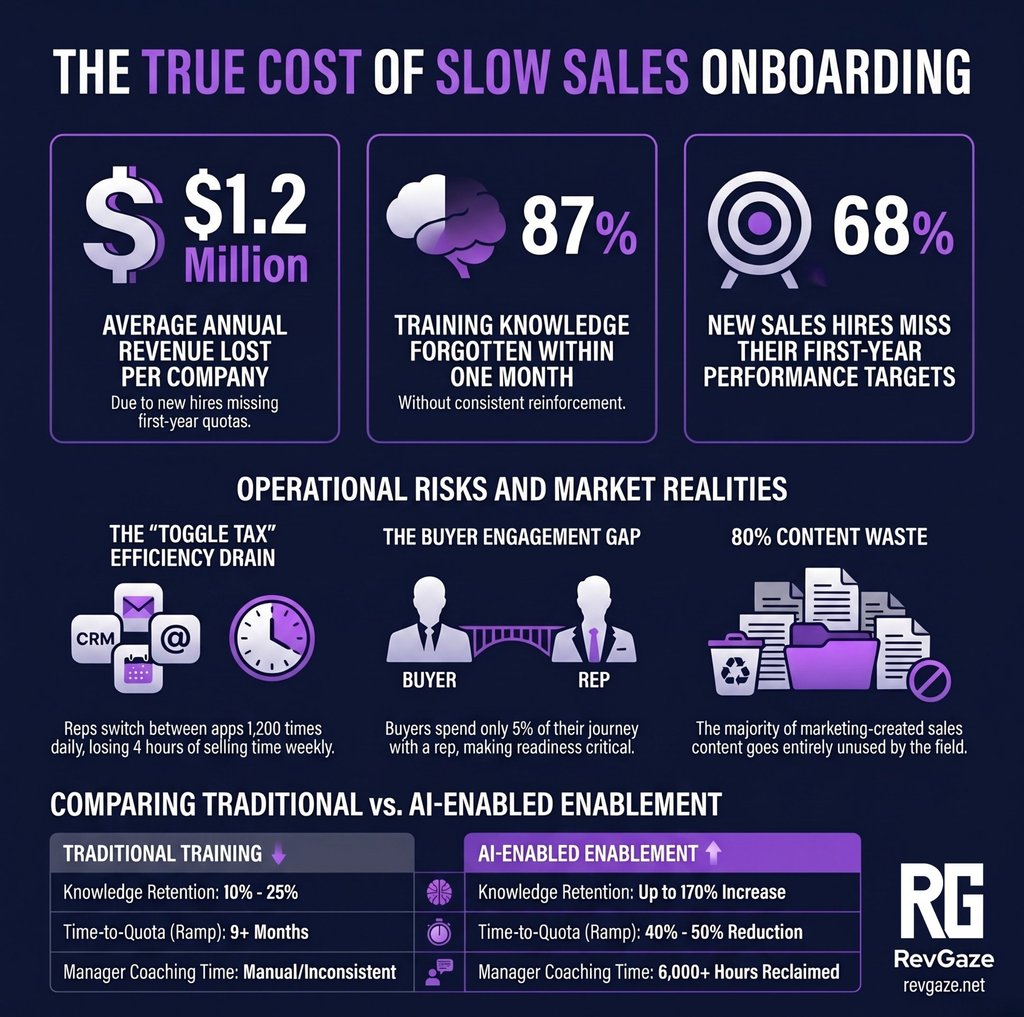
It's a list of things the founder already knew, written in a rush, read once by the new hire, and never opened again. And there's research behind why this doesn't work. Roughly 87% of training knowledge is forgotten within a month without continuous reinforcement. A document in a folder doesn't reinforce anything.
What the companies that get it right actually do ?
They treat knowledge transfer as infrastructure. That distinction matters more than it sounds.
It means extracting the knowledge that lives inside founders, top reps, and won deals through structured sessions, not a frantic afternoon in Notion, and building it into something that shapes how new hires work day to day. Not a PDF that gets read once. A system that makes the right answer findable when you need it.
And onboarding isn't the same as training. Training is an input. Onboarding is the output. You can train someone perfectly and still have a six-month ramp if there's nothing to back it up once they're in the field.
Companies that build this kind of system properly see onboarding time cut by 40-50%. Their third and fourth hires perform closer to their first, because the knowledge that made the first rep successful is finally somewhere it can be used.
Before you post the next job
If you're planning another GTM hire, run one question first: if that person can't get 30 minutes with you this week, what do they use to figure out how to sell?
If the answer is they'd ask the first rep or they'd figure it out, that's the thing to fix before they start.
RevGaze builds the onboarding and knowledge systems that B2B sales teams actually need, so reps ramp faster, sell more consistently, and don't depend on institutional memory that only lives in a few people's heads.
Get in touch with RevGaze today
and let's turn your chaotic onboarding process into a competitive advantage. Your future hires (and your sanity) will thank you. 🎯